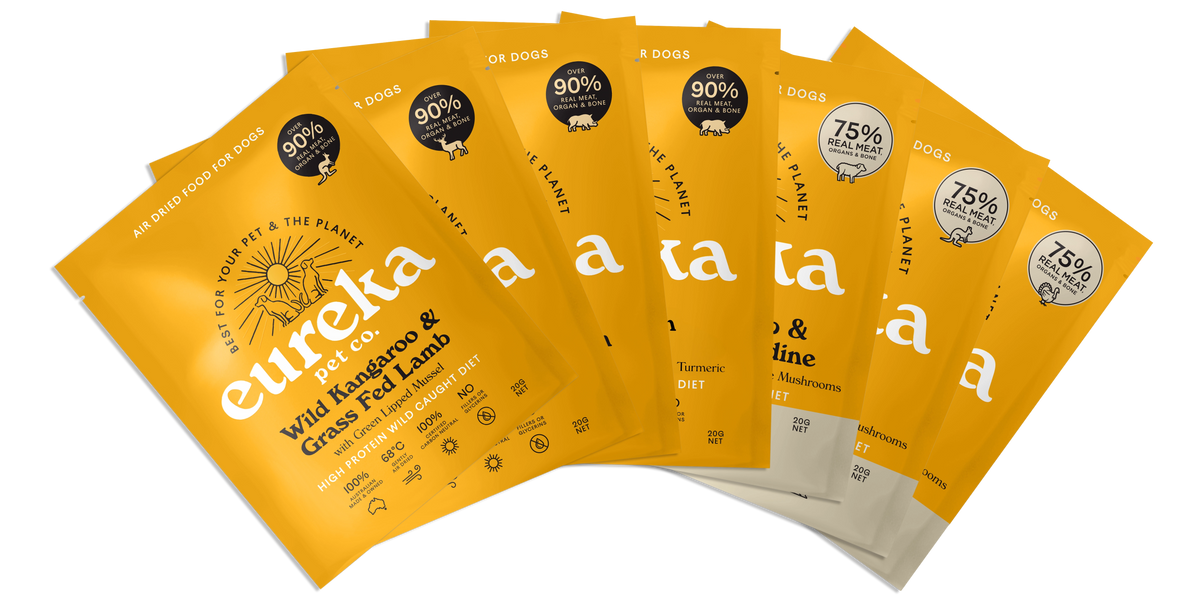
What Are the Best Dog Training Treats?
The treat you reach for during training determines how fast your dog learns, how long they...

What Are the Best Dog Training Treats? | Eureka Pet Co - Eureka Pet Co
Skip to content Made in Australia
The treat you reach for during training determines how fast your dog learns, how long they...
The treat you reach for during training determines how fast your dog learns, how long they stay focused, and whether the session is worth doing at all. Choosing the right treat is not a small decision. Browse Eureka's air-dried dog treats and you'll understand why ingredient quality is part of that equation.
Before you look at any specific product or protein, it helps to know what actually makes a treat work for training. There are five things that matter.
Air-dried treats tick all five. The drying process concentrates flavour and aroma into a small, dense piece without any additives. Intensely rewarding, easy to break into tiny pieces, and nothing in there that shouldn't be.
Different proteins suit different dogs, training styles and environments. Here is how they compare:
| Protein | Best For | Training Value | Shop Treats |
|---|---|---|---|
Chicken | Everyday training, puppies, familiar environments | Medium-high | |
Beef | High-distraction environments, motivating reluctant dogs | High | |
Lamb | Sensitive dogs, everyday reward-based sessions | Medium | |
Kangaroo | Novel protein, high-stakes tasks, dogs with sensitivities | Very high | |
Venison | Dogs with chicken or beef intolerances | High | |
Fish | Recalls, difficult behaviours, strong-scent situations | Very high |
A useful rule: the harder the task or the noisier the environment, the higher-value the treat needs to be. Save the fish and kangaroo for the big asks.
Puppies have smaller mouths, developing digestive systems and shorter attention spans. They need tiny, soft pieces that are easy to chew and gentle on the gut. Chicken and lamb are good starting proteins. See Eureka's puppy range for age-appropriate options.
Adult dogs can handle a broader range of proteins and longer sessions. Treats can be used more strategically here, with lower-value rewards for familiar behaviours and higher-value ones for new or difficult tasks.
Senior dogs often have dental sensitivities or digestive changes that make soft, easily digestible treats the safest choice. Novel proteins like venison or kangaroo are also worth considering as food or treats for older dogs who have developed intolerances over time.
A good starting point is keeping treats to around 10% of your dog's daily calorie intake. For a medium-sized dog on 400 to 500 calories a day, that is roughly 40 to 50 calories worth of treats.
The air-dried advantage is real here. Because flavour is concentrated in every small piece, a thumbnail-sized bit delivers the motivational punch of a much larger conventional treat. You can reward more frequently, which is exactly what effective training requires, without blowing the calorie budget.
A few practical tips:
Ingredient quality has a direct impact on how your dog feels during training, and a dog that is uncomfortable, itchy or bloated will not focus.
Treats loaded with fillers, artificial colours and preservatives are a common cause of skin flare-ups, loose stools and low energy. If your dog seems flat or disinterested mid-session, the treat itself might be the problem.
For dogs with sensitivities, single-protein treats simplify everything. One ingredient means you know exactly what triggered a reaction and what to avoid. Eureka's functional treats are built on this principle: real meat, no corn, no soy, no rice, no glycerin, no guesswork. 100% Australian made and owned.
Clean ingredients also mean consistent energy. No sugar spikes. No crashes. Just a dog that is focused, motivated and ready to work.
Training works better when the reward is worth it.
Browse the full range of Eureka air-dried training treats, pick the protein that suits your dog, and start your next session with a treat that actually delivers. Australian made, single ingredient, nothing your dog doesn't need.
Can I use any treat for dog training?
Not all treats are equally effective. The best training treats are small, smelly, soft and low in calories. Everyday kibble can work for low-distraction sessions, but a high-value treat makes a real difference when you need your dog's full attention.
Are air-dried treats good for training?
Yes. The drying process concentrates flavour and aroma into a small piece with no fillers. They are easy to break up, made from real meat, and intensely rewarding without the calorie load of a larger conventional treat.
Can training treats cause weight gain?
They can if portions are not managed. Keep treats to around 10% of daily calories and reduce the main meal on heavy training days. Air-dried treats help because their intensity means smaller pieces still get a strong response.

Dog Ownership
Summer's coming, and if you're anything like us, that means working out one thing above all else: finding good beaches for dogs that actually tick...
Feeding Advice
Raw feeding does right by dogs, but it asks a lot of you: a chest freezer, strict prep, a defrosting schedule. Kibble is easier, but...

Feeding Advice
Chewing isn't a bad habit, it's a biological need. Leave a dog without an appropriate outlet and they'll find one themselves, and it's rarely the...
Grab a Taste Tester pack and get a $20 credit towards your first subscription order. All seven air-dried recipes, free delivery, just $19.99. Let your dog do the judging. Their opinion's the only one that counts.